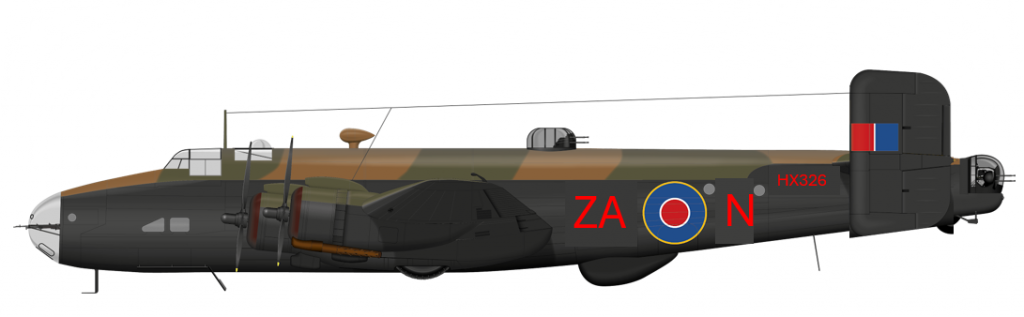
When flight engineer Brinley Weare walked out of the briefing room in his lucky flying boots at RAF Melbourne in Yorkshire. So far he had flown to Germany on twelve occasions and the operation tonight was to be his thirteenth. His 10 Squadron crew would have to fly a new Halifax B Mk III, HX326 [ZA-N], as their own aircraft was being serviced.
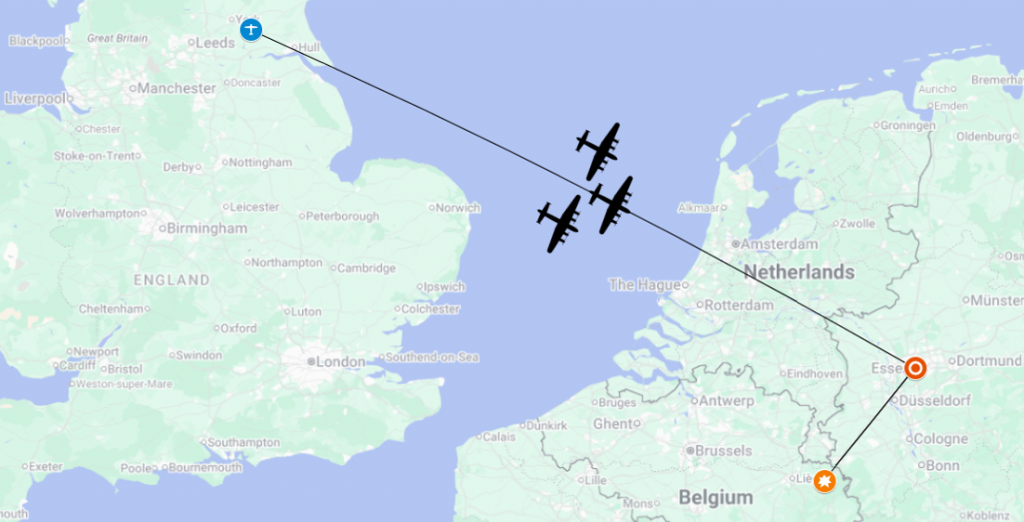
The target was Essen, which to most aircrew was known to be a tough one. “It was uncanny,” he recalled. “None of the crew spoke; we were absolutely silent from the briefing to the aircraft. The wireless operator, David Cooper, owed somebody some money and went straight away and paid up. I was 19 years old. Only two years before I had been working in the Co-op at Watford and here I was, about to climb into a four-engined bomber, and fly right into the heart of the German defences.”
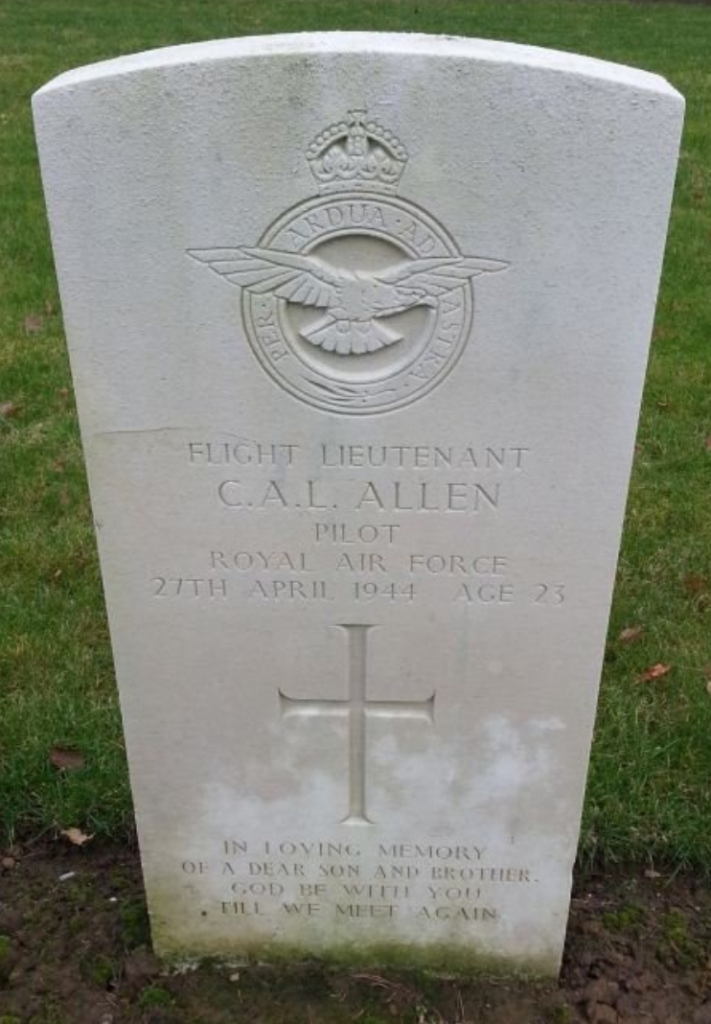
On their way home whilst over Limburg in Belgium, they were hit by flak in the nose and were attacked by two fighters at the same time. The starboard wing was set on fire, and Brinley, the Flight Engineer, cut the engines. The skipper, Flt Lt Cliff Allen, gave the order to bale out. The bomb aimer and the navigator had both been killed, the two gunners also. They were at 23,000 feet, with the Halifax lurching all over the sky. Brinley selected his parachute and crawled into the pitch darkness of the shattered nose. There he found the body of the navigator lying across the escape hatch. He tried to lift him up to get the escape hatch open, but of course he was a dead weight, and Brinley collapsed from lack of oxygen. “I felt warm and comfortable just like when you drop off to sleep. Just then the aircraft went into a dive, then a spin, then it blew up!” The cold sub-zero air brought him back to consciousness. As he was falling, he jerked the rip-cord, but nothing happened! In desperation he clawed at the parachute pack on his chest. Looking up, he saw with great relief the canopy open out. “My body jerked then slowed down, but my lucky flying boots did not – they kept going! When I hit the ground, I just ran, ran and ran in my stockinged feet. Eventually I collapsed in a small wood. Five of the crew had been killed, with only Brinley and the wireless operator surviving. David Cooper was captured to become a POW.
When he awoke again it was about 7 a.m. He was very cold, and his head seemed to belong to somebody else. He looked down at his leg and could see a piece of shrapnel sticking out of it. “And so I began smoking the 20 cigarettes that I had with me, during which time I carved the shrapnel out of my leg with my knife. I bound up my leg and started walking again, and for the next three weeks I slept during the day, under trees and bushes, and travelled by night”.
One day he came to a long strip of concrete which he took to be the start of a road, but it turned out to be a runway, and in Belgium. It was a German airfield, as he was soon to find out, for the door of one of the huts opened and out came a German, luckily he was not seen. He then entered a small wood and came face to face with two men. “We were as surprised as each other, but luckily they were members of the Resistance and took me to a farmhouse. Here, there was a little old woman, with her two sons and a daughter. The girl insisted on bathing my feet, but it took me about 10 minutes to get my socks off. I was given a couple of eggs and a small piece of bacon, which after living on raw potatoes was a banquet indeed. The problem now was how to get me away. The two men were from the White Brigade as the Belgian Resistance was called. They found me a civilian suit and a pair of clogs and we walked along the railway line to the nearest town which was Tienen”. (25 miles to the East of Brussels).
“There were Germans in the main street when we arrived at a café full of troops drinking beer. I strolled through them not knowing quite what was going on”.
He hid in this café for 3 days, when a smartly dressed man arrived, who asked Brinley all sorts of questions. Not knowing who he was, he only gave his name, rank and number. The next day he returned with another man, and Brinley was once again interrogated. By now, the Germans were so near, that every day was adding to Brinley’s tension. That evening they took him to another house in Tienen, where he stayed with a butcher and his wife. The house was situated just across the road from Gestapo Headquarters!
The problem now was how to get him away. This they solved in a novel fashion. “Then they turned up one day carrying a coffin, took off the lid and told me to get in. Being only 19 and not really wanting to be transported in a coffin for a while yet, I said, ‘No fear, I’m not getting in there’. They said, ‘Yes, yes, you must it’s the only way – we have worked it out.’ So reluctantly I got in and the lid was replaced with just enough of a gap for me to breathe. Nevertheless, it was very dark and not at all pleasant. They took me out to a hearse and drove me to a chapel, where I got out, and its original occupant was put back and buried!
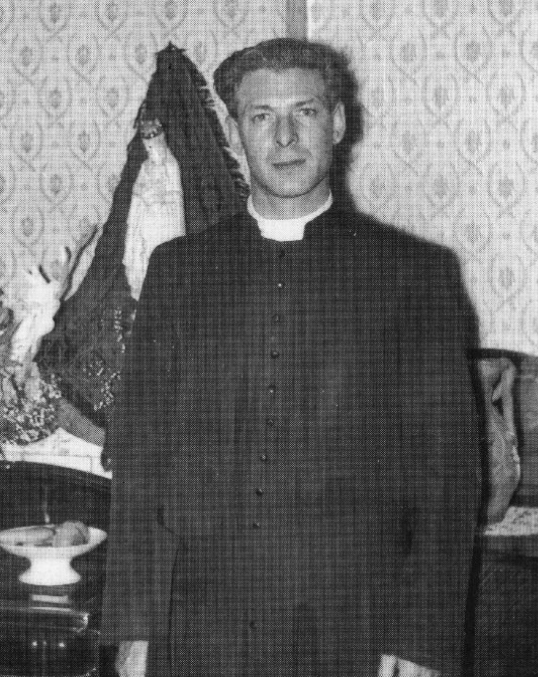
“Here I met someone whom I would remember all my life, a priest, Father Pieter Palmaerts. He gave me a spare cassock and collar. What I did not know at the time, but later found out, was that while I was being taken to the chapel in the hearse a squad of German soldiers were marching in the opposite direction towards us. They had stopped and made a passage for the hearse and presented arms to the coffin. What would have happened if they had insisted on escorting us to the grave side is anyone’s guess. Maybe I would have been buried alive at the tender age of 19?”
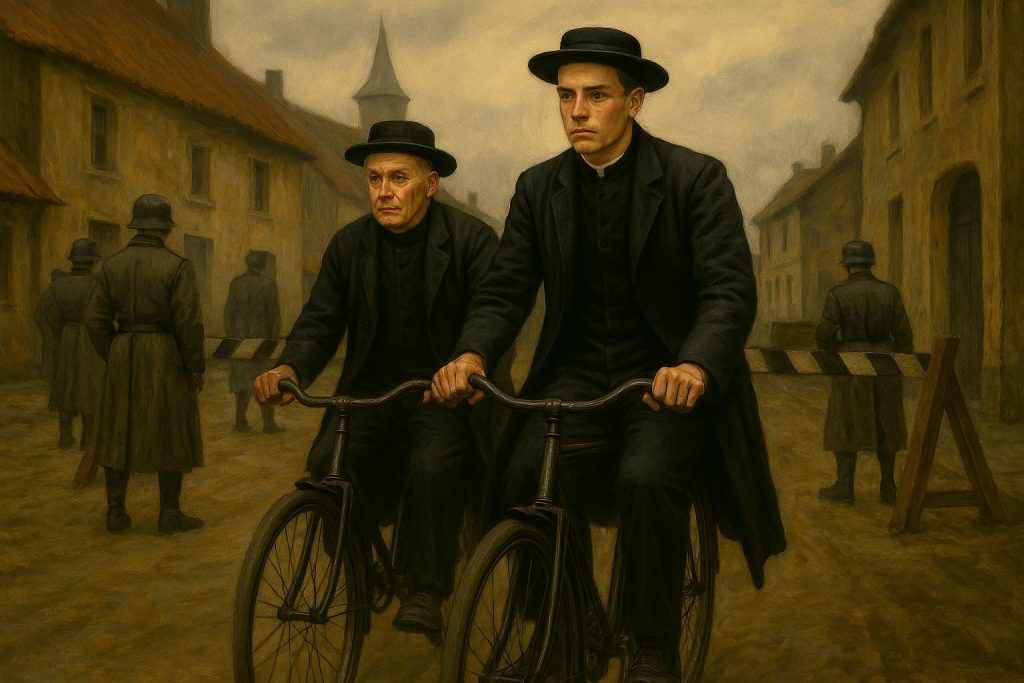
Brinley was given a bicycle and with Father Palmaerts, cycled through the middle of Tienen, but he did not make a very convincing priest. For one thing he was riding on the wrong side of the road, and for another he was whistling. They attracted the attention of a German who was controlling the traffic, but the Father made out to him that Brinley was heading for a cycle track on the left-hand side of the road. This somewhat bizarre journey led him to the village of Glabbeek (4 miles further north), where he was sheltered by the village schoolmistress, Emma Beuyninckx, and her nephew Karel.
“If the Germans were around, I crawled through a trap door under the floor boards, my only companion being a huge spider. My hair was dyed blonde and I was given false papers. During the day I was the never seen son, Constance Van Lack; during the night I worked with the underground, but that is a story I wish to keep under my borrowed cassock”. One souvenir Brinley had from those days was a Nazi officer’s silk handkerchief. All he would say about it was that the officer did not need it anymore.
After a while Brinley was told that an aircraft was coming to pick him up and got ready to leave. Somehow the Germans got wind of it however and began searching the villages. “They found me in the garden, but my Flemish was now good enough to deceive them to such an extent that I helped them look for me!” But in the next village where a Canadian was hiding, things did not go so well. Germans stormed the house, and when the Canadian made a dash for it, they caught and killed him.
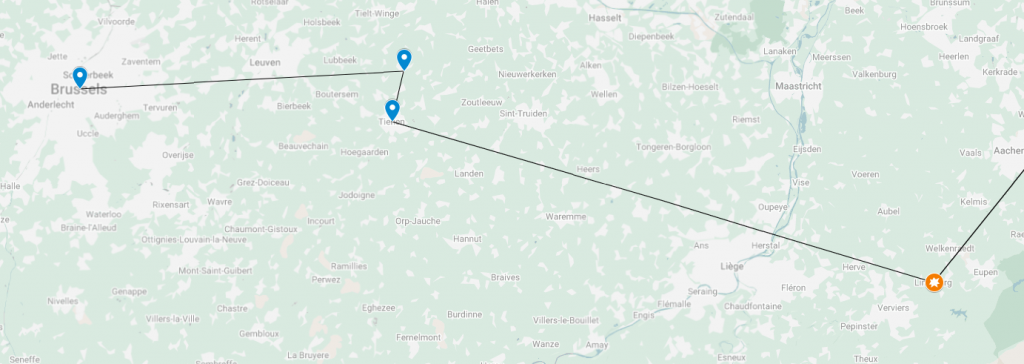
Brinley stayed in Glabbeek until the British Army arrived in the village on 14 September 1944. He’d evaded the enemy for almost 5 months. A German list of people’s names was found and showed 100 people in the village were under sentence of death. Emma Beuyninckx, Brinley’s schoolmistress protector, was at the top of the list. Brinley was sent to Brussels where he was interviewed, then sent home to England. “When I walked into my parents’ home in Watford they looked at me as if they were seeing a ghost as they believed I was dead”.
Father Palmaerts died on 22 March 1986. To the time of his death, he had on his bedside table the photograph of Brinley Weare, dressed as a priest.